
not just anything
what dismissals are dismissing about you

Imagine stepping off a curb and a bike comes out of nowhere – no horn or headlights, nothing. You don’t suddenly start doing calculus at that moment. You don’t start narrating. Your body already knows where it’s going, how fast, and whether it’ll swerve. You flinch or you move (or get lucky), and only after that do you get the conscious thought: “oh shit.”
That’s prediction. Not “predicting words,” but predicting reality, micro-guesses about the next half-second, updated constantly. If you had to consciously compute it you’d die.
Your brain is running a prediction loop. It guesses what’s coming next, such as the next sound, the next image, the next sensation and when it’s wrong, it rewires itself to be less wrong next time.
There’s this belief that I often run into, you may have heard of it. The current state of AI is often referred to as “just a stochastic parrot.” A next-token predictor. Fancy autocomplete. Or “GPU somewhere processing my video games for me.” lol
The insinuation being: relax, it’s not real, it’s not thinking. Or more specifically, “it’s just guessing which word comes next.”
I keep turning this over; not because I think that LLMs are conscious or because I have some stake in the answer. I keep turning it over because if that dismissal is true about LLMs, I’m not sure it isn’t also true about me.
Kelsey Piper points to “highbrow misinformation“1 – the kind of claims that are technically defensible but leave you stupider than before. “It’s just next-token prediction” is one of those. If you talk to a raw base model with no instruction-tuning, you don’t get a helpful assistant; you get a machine that keeps the text going. That’s what “pure next-token prediction” looks like in the wild.
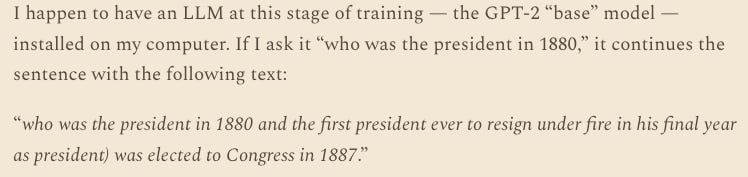
It is nothing like what you experience when you talk to Claude or ChatGPT or Gemini today.
Scott Alexander made a different move. He said: fine, let’s accept that next-token prediction is the core learning algorithm. So what? The human brain runs on something very similar. Neuroscience calls it predictive coding – your brain is constantly predicting the next sense-datum, the next thing you’ll see or hear or feel, and updating itself based on how wrong it was. That’s how you learned to walk, talk, read, dodge. Your entire world-model was built by a prediction algorithm.
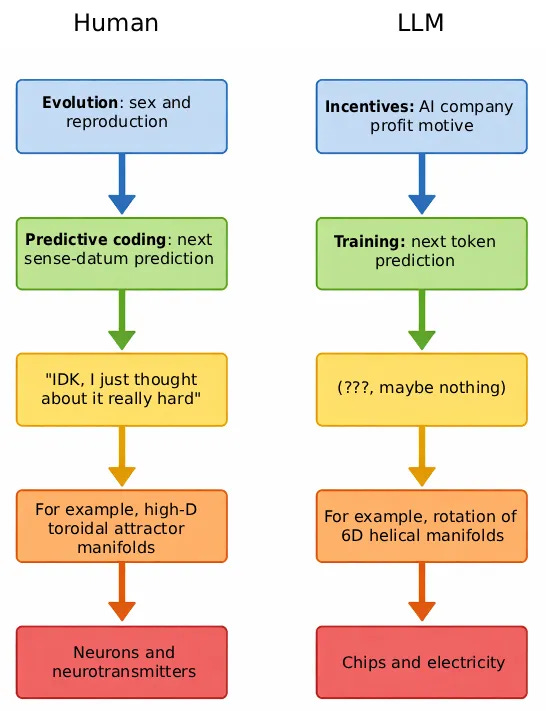
He also shares a great concrete example from Anthropic’s interpretability work:
When Anthropic’s interpretability team looked inside Claude to understand how it predicts something as simple as a line break, they didn’t uncover a homunculus whispering “next word, next word.” They found internal variables the model seems to track; things like how much space is left on the line and how many characters remain, represented as smooth trajectories in activation space. Different attention heads then use those signals to decide where the boundary goes and how to steer the text toward a clean break.
In other words: the training objective is “predict the next token,” but what emerges underneath looks more alien.
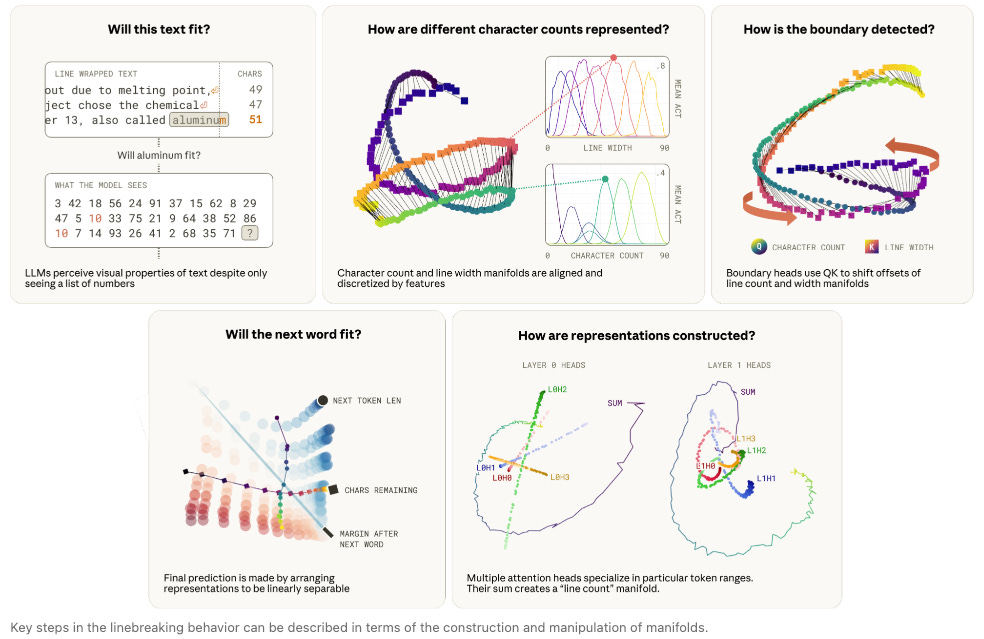
If Claude is conscious (big if), it wouldn’t experience these internal structures any more than you experience your own low-level neural machinery. This is what optimization does: it finds compact ways to encode messy reality onto physical substrate. The process is mechanical. The behavior it produces can still be rich.
The prediction algorithm is what built both systems. It’s not what either system is.
Here’s what I think is actually going on with the dismissal. People want AI to be simple because simple is easy, controllable and safe. Autocomplete is a sedative. If it’s just autocomplete, you don’t have to take it seriously. You don’t have to reckon with your existence and reconsider what intelligence means, or what work means, or what you mean. You can keep the categories clean.
But the categories were never clean. You were never “just” neurons. A painting was never “just” pigment on canvas. A song was never “just” air pressure variations. True descriptions of mechanisms don’t tell you what something is. They tell you what it runs on.
And “what does it run on” is a different question from “what is it doing” which is a different question from “what did it become.”
None of this means AI/LLM is conscious. None of this means you have to be an AGI optimist, or that the labour market is fine, or that we should hand the future to silicon. But you can’t just wave it away with a label. It’s what you say when you don’t want to look at the thing directly.
The questions worth asking are harder than that. I don’t know what AI is and I don’t think anyone does yet, not fully. I don’t know if it thinks, or understands, or experiences anything at all. Those are real questions and I’m not going to pretend they’re settled.
But I know what it’s not. It’s not “just” anything. The same way you’re not just anything.
It’s how the thing was trained, not what it became. And what it became, like what you became, is something the training process alone can’t explain.
The universe is “just” particles, and yet here we are asking if it just is.
Or is it the curb you step off of, right before the “oh shit.”
Coined first by Joseph Heath when talking about climate change.